
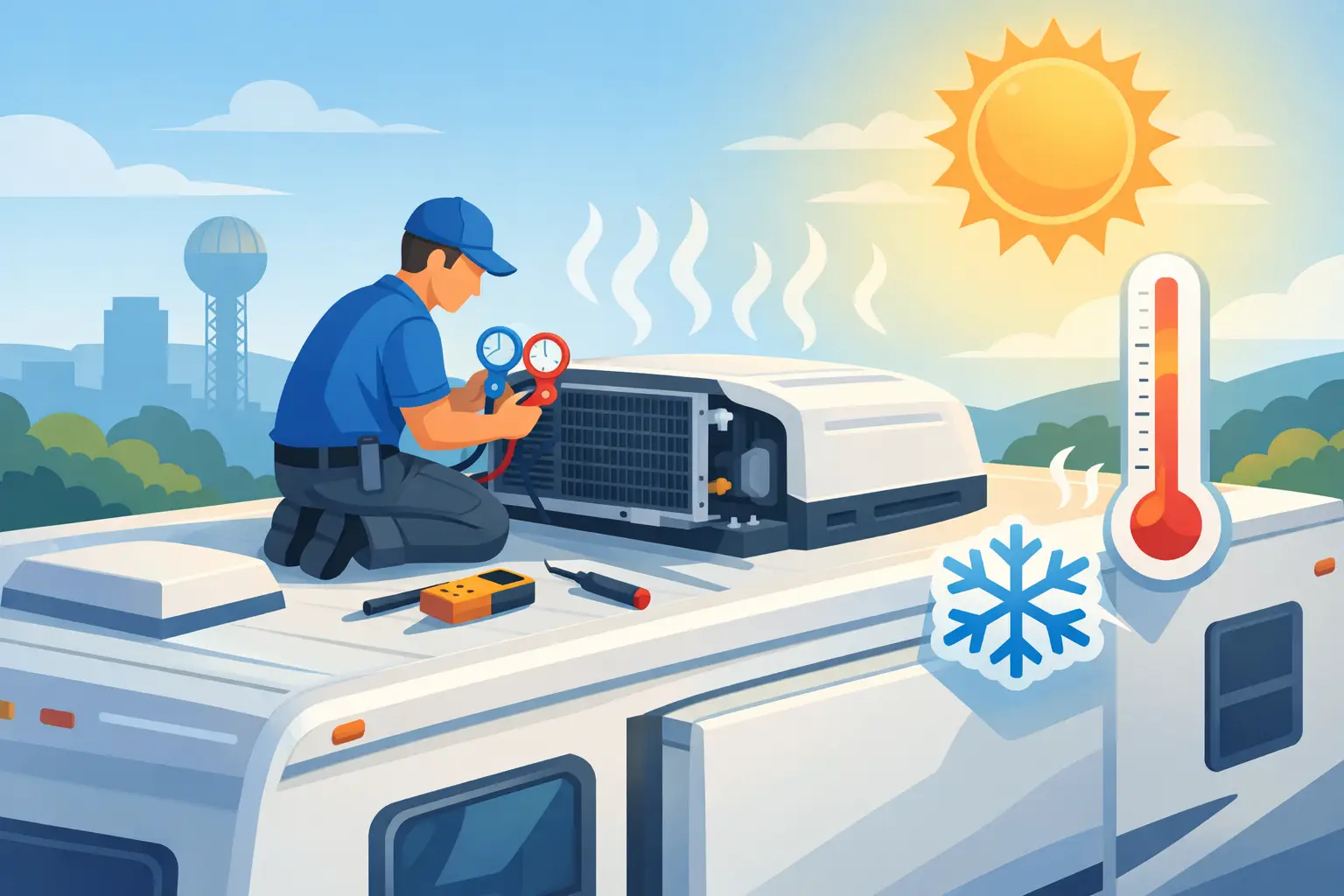
RV AC Repair Knoxville When Cooling Fails
A Knoxville summer can turn a parked camper into an oven in a hurry. When cool air stops flowing, the RV becomes uncomfortable, restless nights follow, and a planned getaway can feel like it is slipping away. Fast rv ac repair Knoxville service matters because the problem may be a simple power issue, a worn component, or a failure that needs hands-on diagnosis before it causes further damage.
For travel trailer, fifth wheel, and camper owners, the goal is not just to get air moving again. It is to make sure the unit is cooling safely, draining properly, and ready for the next stretch of hot, humid Tennessee weather.
When Your RV Air Conditioner Needs Attention
An RV air conditioner rarely fails without giving some warning. You may notice that the fan runs but the air never gets cold, the unit cycles on and off too often, or the cooling is weaker than it was last season. A musty smell, unusual rattling, water dripping inside the RV, or a breaker that trips when the AC starts are also signs that should not be ignored.
In East Tennessee, high humidity adds another layer to the problem. Your AC does more than lower the temperature. It pulls moisture from the air. If it is struggling, the RV can feel sticky even when the thermostat says the temperature is reasonable. Condensation can also build up where it does not belong, creating the risk of ceiling stains, wet insulation, or mold growth.
A loud rooftop unit does not always mean the entire air conditioner must be replaced. Loose mounting hardware, a worn fan motor, debris around the fan, a failing capacitor, or a damaged shroud can all create noise. On the other hand, a compressor that hums but will not start, repeated electrical trips, or no cooling after basic checks usually calls for a qualified RV technician.
Safe Checks Before Calling for RV AC Repair in Knoxville
A few simple checks can save time and help describe the problem clearly. Start with the thermostat. Confirm it is set to cool and lower than the current indoor temperature. If the thermostat uses batteries, check those as well.
Next, verify that your RV has adequate power. At a campground, a weak shore-power connection or a power pedestal issue can keep an air conditioner from starting correctly. At home or in storage, make sure the RV is connected to an appropriate power source. Many rooftop units need more power than a standard household outlet can safely provide, especially when other appliances are running.
Check the breaker panel for a tripped AC breaker. If it trips once and stays on after being reset, monitor the unit closely. If it trips again, do not continue resetting it. Repeated trips can point to an electrical fault, a failing component, or a compressor issue. For safety, leave further diagnosis to a technician.
Finally, inspect the interior return-air filter. A clogged filter restricts airflow, makes the unit work harder, and can cause the evaporator coil to freeze. Cleaning or replacing the filter is routine maintenance, but do not remove rooftop covers or take apart electrical components unless you know exactly what you are doing. RV AC systems combine high-voltage power, rooftop work, and delicate parts that are easy to damage.
Why Mobile RV AC Service Makes Sense
Getting a large RV to a repair shop is not always realistic when the air conditioner quits. You may be set up at a campground, parked at home, stored off-site, or dealing with a unit that should not be moved until other problems are checked. Towing a fifth wheel or travel trailer just for an AC diagnosis can add expense and frustration to an already stressful situation.
Mobile service brings the repair process to your location. A technician can inspect the rooftop unit, electrical supply, thermostat, ducting, and condensate drainage where the RV is actually being used. That matters because some issues only show up under real conditions, such as low campground voltage, a loaded electrical system, or poor airflow inside a closed-up camper.
Time In Season Mobile RV Repair serves owners throughout the greater Knoxville area, including Maryville, Alcoa, Friendsville, Tellico Village, Lenoir City, Townsend, Sweetwater, Vonore, and Madisonville. Whether your RV is at home, at a campground, or in storage, on-site service removes one more obstacle between you and a working air conditioner.
What a Professional AC Diagnosis Should Cover
A proper RV air conditioner repair visit should go beyond turning the thermostat down and waiting for cold air. The technician should evaluate the power source, breaker, wiring connections, thermostat operation, capacitors, fan function, compressor behavior, and airflow. They should also inspect the mounting gasket and drainage path, since water leaks around a rooftop unit can look like an AC problem when the real concern is the roof seal.
The repair path depends on what is found. A dirty filter, loose wiring connection, faulty thermostat, bad start capacitor, or failing fan motor may be repairable without replacing the complete unit. If the compressor or sealed cooling system has failed, replacement may be the more sensible option, particularly on an older air conditioner.
There is a trade-off to consider with replacement. Installing a new rooftop AC costs more upfront, but it can offer more reliable cooling, improved airflow, and fewer surprises on future trips. Repairing a newer unit with a straightforward electrical or airflow issue is often the better value. A capable technician can explain what has failed, what the options are, and what makes sense for how often you use your RV.
Keep Your RV Cooler Between Service Visits
Preventive care can reduce the chance of an AC failure during the hottest week of the year. Before warm weather arrives, run the air conditioner long enough to confirm that it starts, cools, and drains correctly. Waiting until the first campground trip makes a small issue harder to schedule and more likely to disrupt your plans.
Clean or replace return-air filters regularly, especially if you travel with pets or spend time on dusty roads. Keep vents open and avoid blocking them with bedding, storage bins, or furniture. When parked in direct sun, use awnings, window shades, and vent covers to reduce the heat load inside the RV. Your AC will run more efficiently when it is not fighting every degree of Tennessee afternoon heat.
It also helps to watch your electrical demand. Running the microwave, electric water heater, hair dryer, and air conditioner at the same time can overload certain campground hookups or RV electrical systems. If voltage seems low, lights dim, or the AC struggles to start, reduce the load and have the power situation checked before damage occurs.
Do Not Wait on Water, Electrical, or Burning Smells
Some AC symptoms need prompt attention rather than a wait-and-see approach. Turn the unit off and arrange service if you smell burning, see smoke, hear persistent grinding, find water entering through the ceiling, or experience repeated breaker trips. These problems can affect more than comfort. They may involve electrical safety, roof integrity, or interior water damage.
A working RV air conditioner gives you more than cold air. It protects your comfort, your travel schedule, and the condition of the home on wheels you have invested in. If your unit is struggling, getting it checked where it sits can help you get back to a cool, comfortable RV with less disruption and more confidence for the road ahead.