
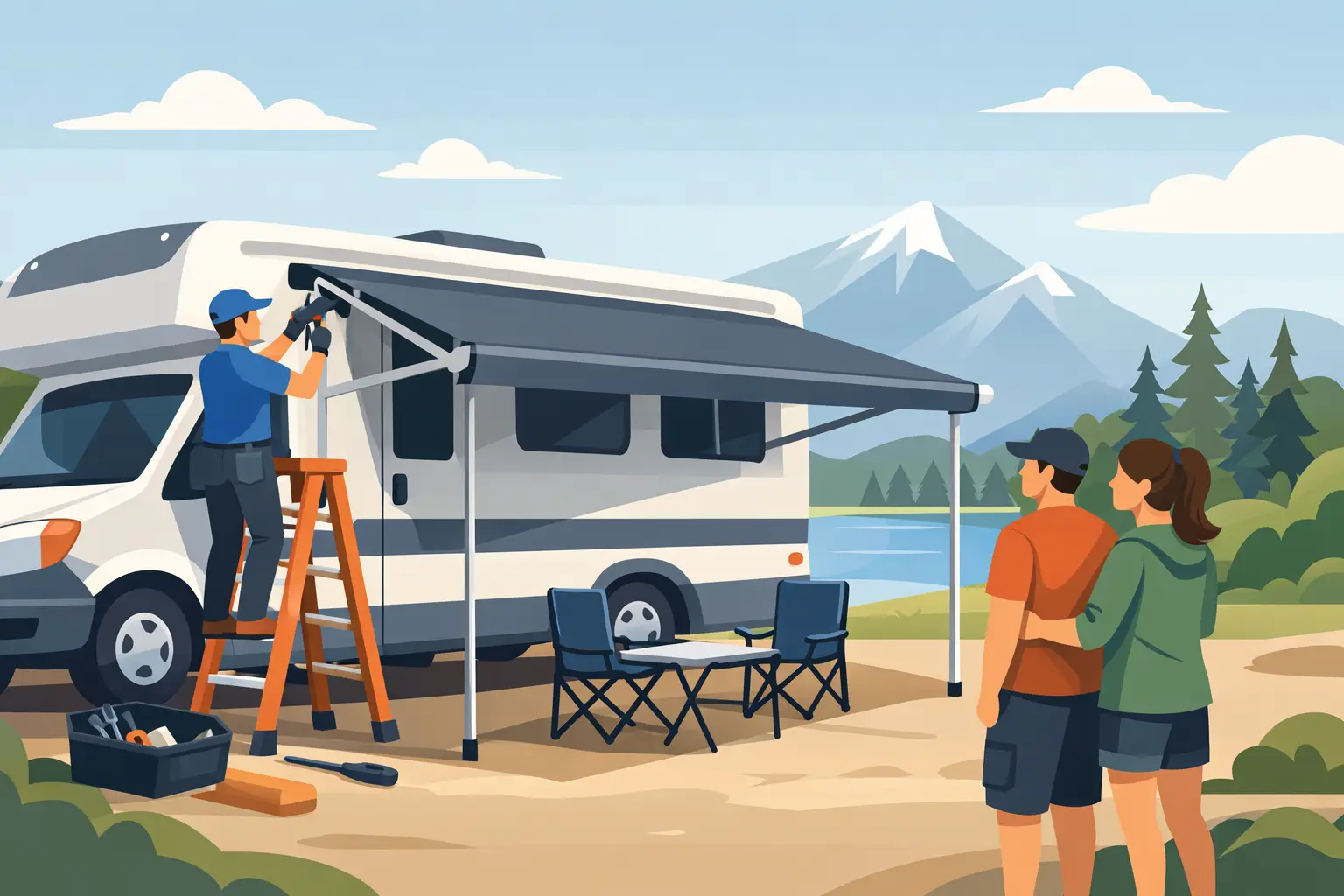
RV Awning Installation Service at Your Campsite
A torn awning can change a comfortable campsite into a hot, exposed parking spot fast. When the fabric rips, the arms will not lock, or a spring-loaded roller stops working correctly, an RV awning installation service helps protect your trailer, fifth wheel, or camper before a small problem turns into costly sidewall or roof damage. Better yet, you should not have to pull a large RV across town just to get shade back.
When to Schedule an RV Awning Installation Service
Awning trouble is not always obvious at first. You may notice a small split along the edge, loose stitching, sagging fabric after rain, or a roller tube that looks slightly bent. These issues can worsen quickly in East Tennessee weather, especially when wind catches an awning that is already weakened.
Schedule service promptly if the awning fabric is badly torn, brittle, shrinking, or separating from its track. Replacement is also a smart call when the fabric has mold staining that will not clean up, when the roller tube is damaged, or when the support arms no longer extend and retract safely. Power awnings need attention when the motor runs without moving the awning, the switch works only sometimes, or one side moves out of sync with the other.
An awning that will not close securely is more than an inconvenience. It can catch wind while you are traveling, allow water into places it does not belong, or create a hazard around your campsite. If you are unsure whether it is safe to move the RV, a mobile technician can assess the condition where it sits.
Replacement, Repair, or a New Awning Assembly?
The right fix depends on what failed. In many cases, a technician can replace the fabric while retaining a sound roller tube, arms, and hardware. That is often the practical choice when sun exposure has worn out the vinyl or acrylic material but the awning still operates properly.
A full assembly replacement may make more sense when the roller tube is bent, the arms are twisted, the mounting brackets are loose or damaged, or several components have reached the end of their useful life. With a power awning, the diagnosis may point to a motor, wiring connection, control switch, or sensor rather than the fabric itself.
There is a trade-off. Reusing good components can control costs, but it does not make sense to install new fabric on hardware that is likely to fail next season. A careful inspection helps you spend money on the repair that will hold up, not just the quickest-looking fix.
Why Proper Installation Matters
An RV awning is under tension. Its roller tube, springs, arms, tracks, and mounting points must work together correctly for it to extend smoothly and close securely. Installing fabric or a complete awning without the right setup can lead to crooked tracking, binding arms, loose fasteners, or fabric that pools water.
Proper installation starts with checking the mounting area and confirming the new material or assembly is compatible with your RV. The technician measures the existing setup, examines the rail and brackets, and looks for damage that could affect the installation. On older campers and trailers, that inspection can also reveal hidden concerns such as softened wall material, missing sealant, or fasteners that no longer hold as they should.
Once installed, the awning needs to be tested through its full range of motion. It should deploy evenly, maintain the correct tension, and retract without rubbing or leaving a gap. For electric models, the technician should verify that the motor, wiring, and controls are functioning as expected before the job is complete.
This attention to detail matters when the next pop-up storm rolls through your campground. A properly installed awning is easier to operate, less likely to collect water, and better prepared for normal use on the road.
Mobile Awning Help Where Your RV Is Parked
Moving an RV with a damaged awning can be stressful, particularly if it is stuck open or will not latch. It can also be difficult to get a fifth wheel or travel trailer into a traditional repair shop during a busy season. Mobile service brings the work to your driveway, campground, storage location, or roadside location when conditions allow.
For RV owners around Maryville, Alcoa, Knoxville, Townsend, Lenoir City, Tellico Village, Friendsville, Sweetwater, Vonore, and Madisonville, that convenience can save a full day of hitching up, hauling, and waiting. Time In Season Mobile RV Repair comes to the RV, evaluates the awning issue, and provides hands-on repair support with the same care we would want for our own camper.
Mobile service is particularly useful for seasonal RVs that remain at a campground or storage lot for long periods. If an awning is damaged during a storm, you can address it before your next trip instead of discovering the problem when it is time to leave.
What to Expect During the Service Visit
A good service visit begins with a clear look at the problem, not an assumption that every damaged awning needs replacement. The technician will inspect the fabric, roller, arms, rail, mounting hardware, and, for powered units, the electrical components. Photos and measurements may be needed to identify the proper replacement material or parts.
Some repairs can be completed during the initial visit if the needed parts are available. Other installations require ordering the correct fabric, arm, motor, or complete awning assembly. That extra step is worthwhile. RV awnings come in different widths, projections, rail sizes, colors, and operating styles, so choosing parts by appearance alone can create an expensive mismatch.
Before the work begins, you should receive a straightforward explanation of the recommended repair and what it involves. Ask whether the service includes testing, adjustment, sealing where needed, and a check of nearby roof or wall areas. Those details help ensure the installation addresses the cause of the problem, not only the visible damage.
Help Your New Awning Last Longer
Even quality awnings need regular care. Sweep off leaves and grit before retracting it, since trapped debris can rub the fabric and interfere with the roller. Let the fabric dry whenever possible before storing it, particularly after a humid Tennessee morning or a hard rain. Closing a wet awning for a short time is sometimes unavoidable, but it should be reopened to dry as soon as conditions allow.
Use caution with wind. Awning tie-downs and supports can help in mild conditions, but they are not a guarantee against gusts or severe weather. If wind is building, retract the awning. The safest awning during a storm is usually the one that is fully closed and latched.
It also helps to inspect the seams, brackets, and fabric at the beginning and end of each camping season. Catching a loose screw, small tear, or sticky arm early can prevent a larger installation job later.
A Few Smart Questions Before Booking
Ask whether the technician services manual and power awnings, whether replacement fabric or parts must be ordered, and whether the mounting surface will be inspected for damage. If your awning is stuck open, explain that when scheduling so the visit can be planned with the right tools and safety considerations.
Do not force a jammed awning closed with straps, bungee cords, or improvised tools unless you must secure the RV for immediate safety. The internal springs and arms can cause injury or create more damage when handled incorrectly. Keeping people clear of the awning and calling for help is the better choice.
Your awning should make time outside your RV more comfortable, not add another repair worry to your trip. When it needs attention, getting the right installation and a careful final test can put shade, comfort, and confidence back at your campsite.