
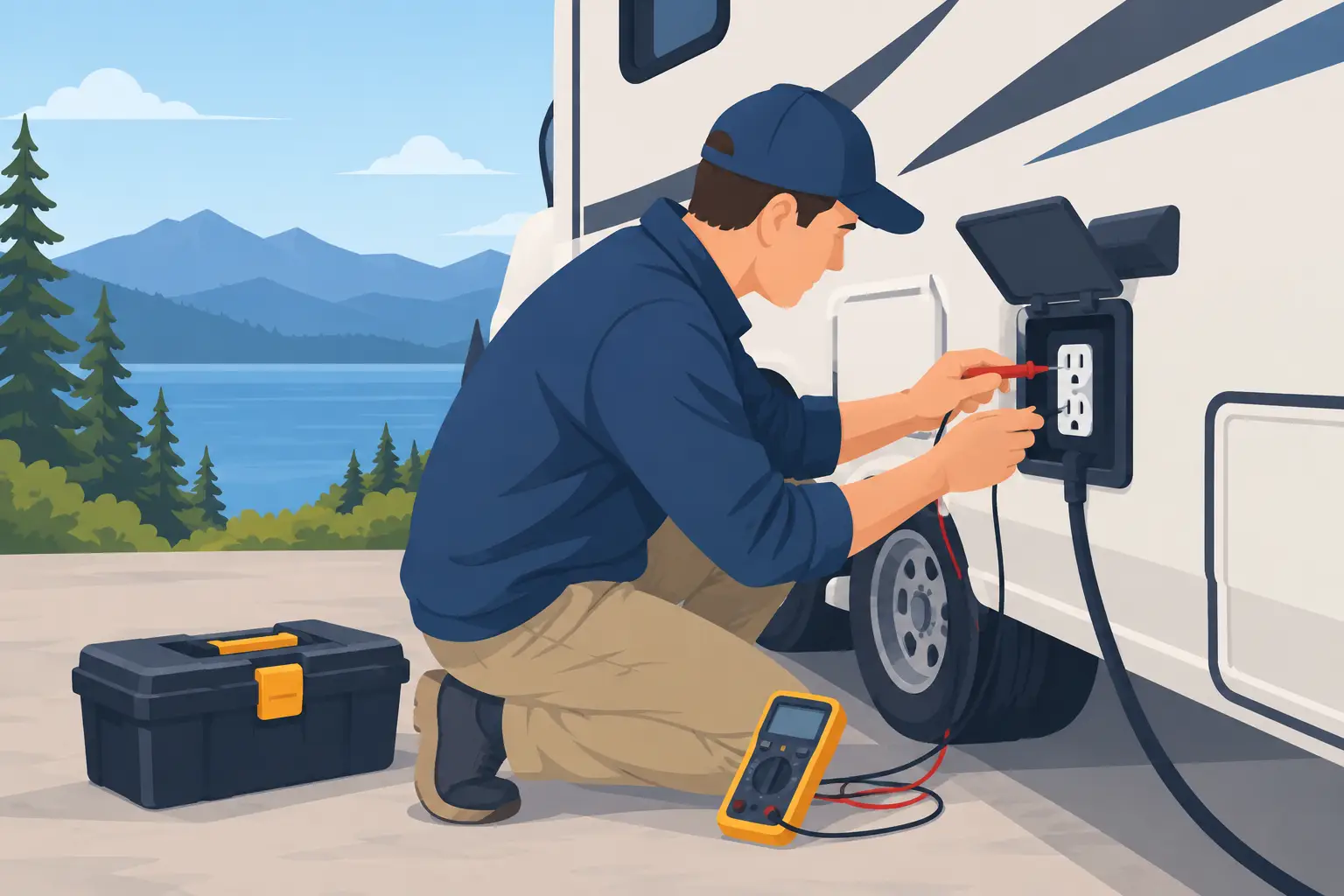
How to Troubleshoot RV Outlets Without Guesswork
A dead RV outlet can turn a normal camping morning into a frustrating scramble. The coffee maker quits, a phone will not charge, or the microwave goes dark even though the lights still work. Knowing how to troubleshoot RV outlets helps you narrow down the problem without taking unnecessary risks around 120-volt power.
Start slowly and work from the power source toward the outlet. Many outlet problems are caused by a tripped GFCI, breaker, campground pedestal, loose shore-power connection, or inverter setting – not a failed outlet itself. If you smell burning plastic, see discoloration, hear buzzing, or find a hot outlet, stop using that circuit immediately and arrange a professional inspection.
First, Determine What Is and Is Not Working
Before opening a panel or pressing reset buttons, check the scope of the problem. Plug a known working device, such as a phone charger or small lamp, into the outlet. Then test another outlet in the RV with the same device.
If every 120-volt outlet is dead, the issue is likely upstream: shore power, the main breaker, the RV’s power cord, the transfer switch, or the inverter. If only one outlet is dead, a tripped GFCI, a loose connection, or a damaged receptacle is more likely. If several outlets in one area are out while others still work, look for a branch breaker or a GFCI that protects that group of outlets.
Do not confuse 12-volt and 120-volt systems. Ceiling lights, vent fans, water pumps, and many USB charging ports may run from the RV battery. Standard wall outlets generally need shore power, generator power, or an inverter. Working lights do not necessarily mean your AC outlet system has power.
Check the Campground Pedestal and Shore-Power Connection
When you are connected at a campground, begin outside. Confirm the pedestal breaker is switched fully on. Campground breakers can trip from an overloaded circuit, a faulty appliance, a wet connection, or a problem in the RV. Turn the breaker completely off, then back on once. A breaker that is sitting between positions may look on while actually being tripped.
Inspect the shore-power plug and cord before handling them. With the pedestal breaker off, look for heat damage, melted plastic, darkened blades, corrosion, cracks, or a plug that fits loosely. Never force a loose or damaged plug into a pedestal. A poor connection can create resistance and dangerous heat, even when some outlets still appear to work.
If the pedestal has another compatible outlet and you have the proper adapter, testing there may help identify whether the problem is at the pedestal or in the RV. Use only a properly rated adapter and cord. A lightweight household extension cord is not a safe substitute for an RV shore-power cord.
At home or in storage, check the house outlet or dedicated RV receptacle as well. A tripped breaker in the home panel can look exactly like an RV outlet failure.
Reset the RV Breakers Correctly
Your RV’s AC breaker panel is often near the entry, under a bed, inside a cabinet, or in a storage compartment. Find the panel and look for a breaker that is out of line with the others or sitting midway between on and off.
Reset a suspected breaker by moving it firmly all the way to off, then back to on. Simply pushing a partially tripped breaker toward on may not reset it. Check the main breaker too, particularly if all outlets are dead.
If a breaker trips again right away, leave it off. Repeated resetting can worsen a short circuit or overload. Unplug appliances on that circuit first, including space heaters, electric griddles, hair dryers, portable air conditioners, and chargers. These high-draw items can easily exceed the capacity of a single RV branch circuit, especially in an older camper or when several appliances are used at once.
A breaker that trips only when one appliance is plugged in may point to that appliance or its cord. A breaker that trips with nothing plugged in needs further diagnosis.
Find and Reset the GFCI Outlet
A GFCI outlet is designed to shut off power quickly when it senses a ground-fault risk. It usually has two small buttons labeled TEST and RESET. In many RVs, one GFCI protects several ordinary outlets downstream, often in the kitchen, bathroom, exterior compartment, or near the entry.
Look beyond the dead outlet. Check every GFCI in the RV, including outside outlets and outlets hidden in storage bays. Press RESET firmly. If it will not reset, make sure the RV has incoming power and reset any related breaker first.
Moisture is a common reason a GFCI trips. Rain at an exterior outlet, condensation, a wet countertop appliance, or a damp storage compartment can be enough. Let wet areas dry completely before resetting. Do not bypass a GFCI or replace it with a standard outlet. That safety protection is especially valuable in a compact RV where water, metal surfaces, and electrical equipment are close together.
Consider the Inverter, Generator, and Transfer Switch
If outlets work on shore power but not while dry camping, the inverter may be off, in fault mode, or not sized to serve every outlet. Some RVs only route selected outlets through the inverter, often those near entertainment areas or kitchen counters. Others do not have an inverter at all.
Check the inverter display or control panel for a fault message, low-battery warning, or tripped internal breaker. A weak house battery can keep an inverter from supplying usable AC power. Running a high-demand appliance through a small inverter can also overload it quickly.
When using a generator, verify that it is running normally and its output breaker is on. If you recently switched between generator and shore power, a transfer switch issue is possible. Transfer switches and inverter wiring should be inspected by a qualified RV technician. These components carry live AC power and can be damaged by heat, loose wiring, or incorrect connections.
When One RV Outlet Still Will Not Work
When every other check passes and one outlet remains dead, resist the urge to remove it while the RV is energized. Turn off shore power, generator power, and the relevant breaker before any inspection. Even then, RV outlet wiring can be different from residential wiring, and some receptacles use push-in connections that can loosen with road vibration.
A loose wire, cracked receptacle, damaged outlet box, or failed upstream connection may be the cause. Signs that the outlet needs prompt service include a loose faceplate, plugs that fall out, heat around the receptacle, intermittent power, sparks, or discoloration. These are not cosmetic concerns. They can become a fire risk.
If you have electrical testing experience, a properly used outlet tester can help show whether an outlet has an open ground, reversed polarity, or no power. But a tester does not identify every problem, and it should never be used as permission to keep operating a hot, damaged, or intermittently powered circuit.
Know When to Call for Mobile RV Electrical Help
Some outlet issues are simple resets. Others need hands-on diagnosis before they interrupt a trip or create a safety concern. Stop troubleshooting and call for help when you have any of these warning signs:
- A breaker or GFCI repeatedly trips after appliances are unplugged.
- The shore-power cord, plug, pedestal connection, or outlet feels hot.
- You smell burning, see melted plastic, or notice scorch marks.
- Outlets lose power intermittently while driving, on shore power, or on generator power.
- The problem involves the transfer switch, inverter, converter, breaker panel, or damaged wiring.
For RV owners around Maryville, Knoxville, Townsend, Tellico Village, and nearby East Tennessee communities, Time In Season Mobile RV Repair can come to your home, campground, storage location, or roadside stop. A mobile technician can trace the circuit, inspect connections, and make the repair without requiring you to move a disabled trailer or fifth wheel.
Keep an eye on your outlets before a long trip, especially after winter storage or heavy rain. A quick check of the shore cord, GFCI outlets, breakers, and a few commonly used receptacles can catch trouble while it is still a small repair instead of a trip-ending surprise.